
What Is Trauma-Informed Website Design? A Guide for Therapists & Service Providers
What if your website could make people feel safe, seen and heard?
Before someone schedules that initial consultation with you they’re already having an experience with your business through your website. Your words, colors, imagery, navigation, and even the amount of information you provide can either create trust or unintentionally create barriers.
Trauma-informed web design takes the principles of trauma-informed care; safety, transparency, choice, collaboration, and empowerment, and applies them to your website and online marketing.
While this approach is especially important for therapists, coaches, wellness professionals, and trauma-informed practitioners, every service provider can benefit from creating a website where people feel respected, supported, and in control of their decisions.
With millions of people living with trauma, anxiety, PTSD, and traumatic experiences that shape how they interact with the world, designing with empathy is a more inclusive way to build trust with your potential clients while they are still researching who they want to work with.
What Does "Trauma-Informed" Actually Mean?
Trauma-informed care is a framework rooted in the understanding that many people have experienced trauma - and that those experiences shape how they move through the world, how they seek help, and how they respond to environments and interactions.
A trauma-informed approach doesn't require knowing someone's history or what they experienced. It means designing your systems, language, and spaces with the assumption that some (or most) of the people you serve may have a dysregulated nervous system - and making sure your website design, layout and copy are designed with this in mind.
When I’m designing a website for a client, I’m asking: Is this website a sacred space where people feel welcomed, respected, and in control of their experience? Do the colors, layout and messaging take into account who my client wants to serve and what those people may be experiencing when they are visiting this website?
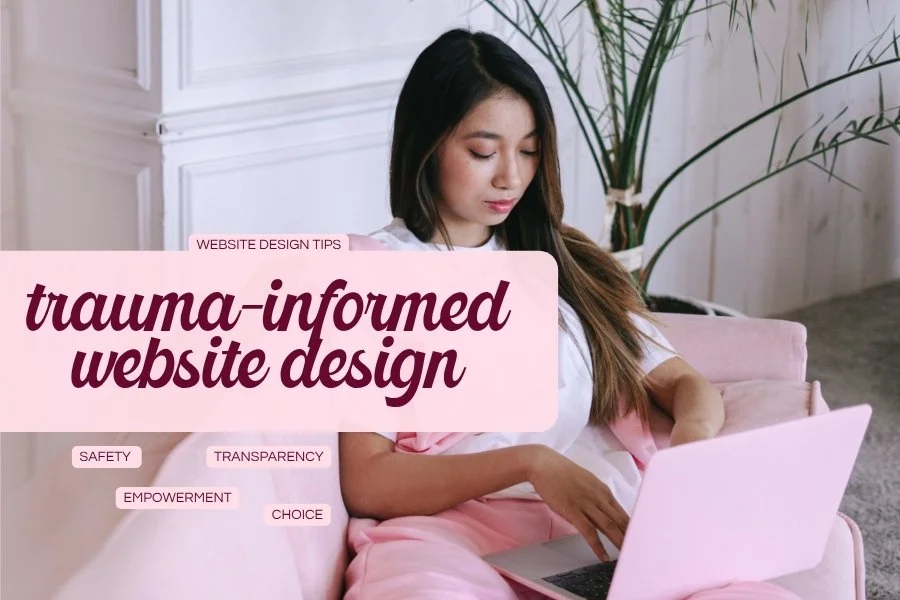
What Is Trauma-Informed Website Design?
If you're a heart-centered service provider, there's a good chance you already bring a trauma-informed lens to the work you do with your clients.
But what about your website?
Your website is often the very first interaction someone has with you and your business. Before they ever book a call, read a testimonial, or hear your voice - they land on your homepage. And in those first few seconds, their nervous system is already making a decision: Do I feel safe here? Does this person get me? Can I trust this?
Trauma-informed web design is about intentionally creating a space where your ideal clients feel seen and heard, especially those who've experienced trauma, marginalization, or chronic distrust of systems and institutions.
Here are some examples of trauma-informed design:
Call to actions that offer choice and collaboration. Such as “Let’s see if we are a good fit to work together” then under that can be a button that says “Schedule a Free Consultation”
Imagery that supports the goal, not the pain. I see this so often on therapist and coach websites and it is so damaging, not only to the person visiting your website but to you and your brand. Your images should always invoke a feeling and that feeling absolutely needs to be one of empowerment especially if you are working directly with people experiencing trauma. Choose images that speak to what your client ultimately wants to experience: Freedom, Empowerment, Joy, Connection, etc.
Colors that invoke feelings of the results you offer your clients. There is much debate around color psychology and honestly I think its subjective. Here’s the rule of thumb I follow - colors create a feeling, does the feeling match YOU and what you offer?
So let’s say you are therapist, your personality is calm and joyful and empathic. You aren’t a neutrals kind of person, but you don’t want to use crazy bright colors that are going to feel jarring to your clients. So you pick a palette that has 1-2 dark colors like deep blue or green, 1-2 light colors like white or ivory and 1 brighter accent that feels joyful and light such as yellow, pink or bright blue. Color choices are really about the feeling they invoke and that can be done with bright colors and dark colors when matched correctly.
Principles of Trauma-Informed Website Design
Depending on the industry you are working in trauma-informed design can look very different. For instance, a wedding planner website will not have the same design choices that a therapist website will. Potential clients of a wedding planner may be coming to the website feeling stressed and anxious but also excited; while potential clients of a therapist may be feeling desperate, overwhelmed or depressed. While both websites need to offer a safe space how you go about it won’t necessarily look the same from website to website or industry to industry.
That being said there are a few design choices that remain the same no matter what industry you are in so let’s dive into those now!
Tip 1: Choose Clarity Always
The one thing that will turn anyone off from a website is a lack of clarity. This can look like confusing navigation, vague headlines, and jargon-heavy copy that create overwhelming cognitive load. (Please for the love of god stop using words like “liminal” or “threshold”). When someone who is already managing anxiety, grief, burnout, or hypervigilance, comes to your website and it requires effort to decode it or find what they need that can literally be panic inducing. Especially if they are looking for someone that can help them regulate their nervous system - this is enough to make them close the tab entirely and move on.
Trauma-informed design prioritizes clarity on every page. What do you do? Who is it for? What should I do next? These questions should be answered immediately and effortlessly. No endless scrolling or hunting around for answers. This isn’t just a trauma-informed concept this is good marketing, period.
I cannot stress the importance of an organized website that is clean and clear and includes language that doesn’t require a PhD in English.
Tip 2: Autonomy and Choice
One of the core principles of trauma-informed care is restoring a sense of control and choice to people who may have had those things taken from them. You may have also heard this referred to as “consent-based marketing”. And this is what I specialize in.
On a website, this shows up in small but meaningful ways:
offering multiple ways to get in touch (form, email, phone) instead of forcing one method
making it easy to leave a page without pop-ups that guilt-trip or trap
avoiding aggressive countdown timers or scarcity tactics that manufacture urgency and pressure.
offering call to actions that center choice and clarity like “Let’s Talk”, “Book a Free Consult”, “Explore Services” , “Start Your Therapy Journey” or “Check Availability”
Your ideal client should feel like they're in the driver's seat when they visit your website - because they are. If they don’t feel like they have control, or they feel pressured - your website will not convert.
Tip 3: Inclusive and Representative Imagery
We talked about this a little bit in the last section but let’s dive in, because this is a big one! You know the saying “a picture is worth a thousand words”? The images on your website can make or break it - they should contribute to the overall feeling you want potential clients to have when they visit your website.
A big part of this is inclusion. Who do people see reflected in your website photos? If your imagery skews toward one narrow representation of humanity, you're sending the message to everyone outside that image: this space may not be for you.
Trauma-informed design uses imagery that reflects the beautiful diversity of the humans you actually want to serve - different body sizes, ages, skin tones, abilities, family structures, and expressions of gender and identity. Representation should never be performative. It should be a conscious choice that you make and that is part of the target audience you want to work with.
Also, super important - as mentioned above do not use imagery that speaks to the trauma or negative emotions someone might be experiencing. Don’t show couples in conflict, don’t use images that are sad and depressed, etc. This is TRIGGERING! And it reinforces their current experience, it does not reflect at all that you are the person who could help them.
Instead, use images that speak to what your ideal client wants to experience:
A happy relationship
Freedom and Peace
Success or meaningful relationships
Nature images that promote calm and rest
Read: Where to find free stock images
Tip 4: Language that doesn't exclude or harm
The words on your website matter and they matter more than imagery or colors do. Certain phrases, even well-intentioned ones, can alienate, trigger, or erase people without you ever knowing it happened.
This includes things like defaulting to binary gender language when it isn't necessary, using the word "crazy" or "insane" as casual descriptors, or framing your services around fixing people rather than supporting them. Trauma-informed copywriting is thoughtful, person-first, and rooted in respect. It shows the value you offer clearly not your processes or modalities but how what you do helps your clients - the benefits they receive from working with you.
It speaks to the pain points of your ideal client like you know what their struggle is and you are here to help (not fix, but help guide them toward what is possible). It makes them feel seen and heard.
There is a billboard by my house with a picture of a woman leaning up against a convertible, the wind flowing through her hair and the headline says “Life is short, get a divorce”. At first glance this may not seem trauma-informed, it’s a bold statement. But here is why I love it. The lawyer is a woman (so it feels safe), she is speaking to the pain point that potential women in town have - they feel stuck in their unhappy marriages and she is offering the solution. It’s honestly genius and exactly what I mean about knowing your target audience and speaking to their pain point while offering them the solution they are looking for. Now obviously being this bold isn’t always the best choice but when your copy is in alignment with you, who you help and what you offer - your ideal clients book their consultations effortlessly.
Your copy is so massively important and I cannot stress that enough.
Tip 5: Sensory-considerate design
Flashing animations, auto-playing videos with sound - ughhhh (hate this one), aggressive color contrasts (or no contrast at all), and cluttered layouts aren't just bad design - they can be genuinely disorienting or distressing for people with sensory sensitivities, PTSD, or neurological differences.
This isn’t to say that you can’t use motion on your website at all or include bright colors, it’s all in how its done. Subtle movements are great, they can create engagement and a luxurious feel to your website. Bright colors can create feelings of excitement, fun and encouragement.
Choose your design elements with intention not just because they look pretty or fun at the time but because you intentionally are creating a feeling that you want your target audience to have when they visit your website.
Tip 5: Accessibility
Trauma-informed design and accessible design overlap significantly, because both center the full range of the human experience. This means ensuring your website works for people using screen readers, people with low vision, people navigating with a keyboard instead of a mouse, and people on older or slower devices. Sometimes all of these things are not available to use, but making sure that your website is accessible as humanly possible is key.
does trauma-informed design matter If You Don't Work With Trauma Directly?
Hard YES! You don't have to be a therapist, counselor or trauma-informed practitioner for this to be relevant to your work.
Whether you're a coach, a doula, a nutritionist, a designer, a wedding planner, a photographer, a home organizer, or any other kind of heart-led service provider - the people coming to your website are whole humans with full histories. Some of them are navigating really hard things. Some of them have been burned before by services that overpromised and underdelivered. Some of them have felt invisible in spaces that claimed to welcome everyone.
A trauma-informed website says: I see you. You're safe here. I’m here to help.
Websites that are clear, accessible, and emotionally safe convert better. They attract clients who are genuinely aligned with your values. They reduce mismatched inquiries. They build the kind of reputation that generates referrals and word-of-mouth without you having to hustle for it.
When people feel good on your website, they begin to trust you before they've even met you. And trust is the foundation of every single client relationship you'll ever have.
Trauma-informed design is what I specialize in…
Trauma-informed website design is exactly what I do, I’m passionate about inclusivity and helping both my clients and the people they serve feel seen, heard and safe.
I'm not interested in building websites that look gorgeous but make people feel unseen. I'm not interested in using high-pressure tactics that manipulate people into booking. I'm interested in building websites that feel good and that honor the humans on the other side of the screen while reflecting the values of the incredible people I get to work with.
If you're wondering whether your current website is doing this well - or where it might be falling short - the free Website Conversion Checklist is a great place to start.
→ Grab the free checklist here
It walks you through the key elements of a clear, trustworthy, client-ready website - in plain language, with no tech overwhelm. It’s the best place to get started!
Creative Kate Designs builds intentional, ethical, and inclusive websites for trauma-informed practitioners and heart-centered service providers who want an online presence that reflects their values. Based in Grand Junction, CO, serving clients across the U.S. and Canada.